
Computer Accounts
You need to be identified as a collaborator who requires computer accounts on the beam time support request (BTSR) submitted through the User Portal by the proposal spokesperson or their designee.

BTSR checkbox for 'computer accounts required' (After the BTSR has been submitted, if changes are needed, then the spokesperson should directly contact lcls-user-office@slac.stanford.edu)
- LCLS users who need computer accounts must meet the following requirements as listed in User Portal (image below):
- be registered in the User Portal
- have a valid User Agreement
- have a SLAC System ID # , and be listed as Active
have completed Course CS100 - Cyber Security for Laboratory Users Training

User Portal profile 1 
User Portal profile 2
Please complete Cybersecurity training in order to create your computer accounts.
(Note: If you have existing computer accounts, they will be disabled until you have renewed your annual Cyber Security Training.
If you have a new computer account and have not completed this course, then you only have a 5-day grace period to complete this course before your account is disabled.)
- Get your training password by filling out the Training Portal Password Request form
- Click here to log into the Web Training Portal
- Click the red 'Manual Login' box to access the login page where you will enter your SLAC System ID# and the training password which was emailed to you from the previous step.
(Please note, this is a seperate 'Training Portal Password', and not your computer accounts passwords or your User Portal password.)- If you were given a SLAC System ID with the leading zeros, drop them when you enter your number. So 000001234567 becomes 1234567.
- NOTE: YOU WILL BE REQUIRED TO CHANGE TO A CUSTOM TRAINING PASSWORD AFTER YOUR FIRST LOG IN. PLEASE SAVE YOUR NEW TRAINING PASSWORD WHERE YOU CAN FIND IT TO ACCESS THE TRAINING PORTAL IN THE FUTURE.
- If you forgot your training password, you can reset it by using this link
https://slactraining.csod.com/ForgotPasswordAuthentication.aspx?corpName=slactraining
- After log-in, click on the Course Catalog link under 'Start Here'.
- Enter the number (e.g., CS100) and/or name of the course you need in the Learning Search box at the top of the screen to find your course.
- This will bring up the course landing page. Click the Launch button to launch the course.
- Once you have completed the courses, save a screenshot of your certificates of completion in case there is a computer glitch (it may take 2 hours for credit for completed courses to be downloaded into the SLAC training database).
If you have an existing computer account that needs re-enabling, or questions about SLAC Training login and password, please e-mail lcls-accounts@slac.stanford.edu
- Once you have completed the courses, save a screenshot of your certificates of completion in case there is a computer glitch (it may take 2 hours for credit for completed courses to be downloaded into the SLAC training database).
Currently, you will need both the UNIX account and the SLAC account.
Your UNIX account may be needed for some jobs, and your SLAC account is needed for 2-factor authentication login.
This Step 3 is for those who:
- have no existing UNIX account and no existing SLAC account
or - have no UNIX account but have an existing SLAC account
If the requirements in Step 1 and Step 2 are met, then you can log into the User Portal to create both the UNIX account and the SLAC account in one step (See 2 images below).
Or if you already have a SLAC account then this step will simply create the UNIX account for you.
1. Click the link (more info) from the User Profile page.

2. Click on the button 'Request both UNIX Account and SLAC Account', and follow the instructions including reading and agreeing to the 'Use of SLAC Information Resources' agreement. (If you do not see this button, and you have just finished your Course CS100, then please wait a couple of hours and try again after the training data has synched. The username you choose can be up to 8 alphanumeric characters, with no space.)

3. Within 5 minutes, your temporary passwords should be e-mailed to you, please follow the instructions to set your passwords. You will receive 2 separate e-mails, one for UNIX account password and another for SLAC account password.
For your SLAC account, you will receive a 'Secure E-mail' with you login information, if you do not see that e-mail then please check in your Junk Mail.
When you click 'Open' for the 'Secure E-mail', it will ask you to login. If you have not set up an account for 'Secure E-mail' previously, then for 'Username' - please put the e-mail address you received this e-mail at, and then click on 'Forgot password'. You will then be sent the 'Secure E-mail' password. This does not reset the password for the e-mail address you are using, it is simply the password for your 'Secure E-mail' (sorry this is counter-intuitive).
When you first login to your SLAC Account (Active Directory SSO account), you will be instructed to set up 2-step authentication using either:
a) DUO mobile app on your smartphone
or
b) receiving SMS text messages if you don't have a smartphone.
For any problems, please e-mail lcls-accounts@slac.stanford.edu
Starting from 12 January 2026, you will only be able to login with your SLAC Account and DUO 2-factor authentication to all LCLS web applications, and starting June 2026 this will apply to all SSH login to LCLS also.
After you have successfully created your UNIX account, you can login at this link to create your SLAC Account (Active Directory SSO account).
If you already have a SLAC Account, then the 'Create' button is greyed out.)
You will receive a Secure E-mail with you login information, if you do not see that e-mail then please check in your Junk Mail.
When you click 'Open' for the Secure E-mail, it will ask you to login. If you have not set up an account for Secure E-mail previously, then for 'Username' - please put the e-mail address you received this e-mail at, and then click on 'Forgot password'. You will then be sent the Secure E-mail password. This does not reset the password for the e-mail address you are using, it is simply the password for your Secure E-mail (sorry this is counter-intuitive).
When you first login to your SLAC Account (Active Directory SSO account), you will be instructed to set up 2-step authentication using either:
a) DUO mobile app on your smartphone
or
b) receiving SMS text messages if you don't have a smartphone.
For any problems, please e-mail lcls-accounts@slac.stanford.edu
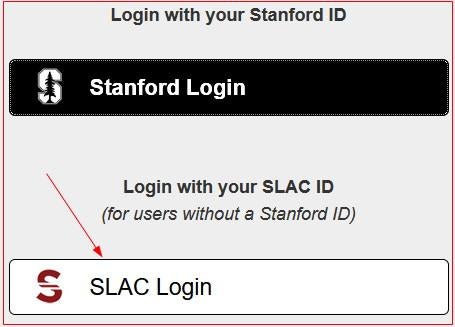
Permissions in LCLS Experiment Portal/eLog is usually automatically set up about a month before the experiment start date, using the accounts of the list of collaborators from the Beam Time Support Request submitted by the Spokesperson. S3DF invitations are also automatically generated as part of this process. If you need access to the experiment earlier than a month - or if you need access to a past experiment, please send e-mail to pcds-help@slac.stanford.edu
If you plan on using psana/Jupyer/OnDemand on our S3DF (SLAC Shared Science Data Facility) compute resources to analyze experimental data, you can request access to S3DF:
- -> Log into coact using your SLAC account
- -> Follow the instructions to enable your account in S3DF for LCLS facility.
If the account creation process fails for any reason, we’ll let you know. Otherwise, you can assume your account will be enabled within an hour.
Confirm Existing Computer Accounts
If you already have a Unix Account and/or SLAC Account, then when you login to the User Portal , the Welcome page will list whether the following conditions have been met for continued use of the account:
- your account name, and whether the account is disabled
- whether the User Agreement is valid
- whether Course CS100 is valid (CS100 training has to be renewed annually)
If any of the above conditions needs to be fulfilled or for other problems with existing accounts, please see troubleshooting section below.
Tips for Troubleshooting Problems with your Computer Accounts
For questions, please e-mail lcls-accounts@slac.stanford.edu
- If you can login with your SLAC Account, you can check on your account status at this link
- If you remember your existing SLAC account password (Active Directory SSO account), you can reset password here:
https://adfs.slac.stanford.edu/adfs/portal/updatepassword
- If your SLAC account is dis-abled (accounts are disabled due to inactivity for 180 days),
or if you don't remember your SLAC account password , you can re-enable or reset password here:
https://identity.slac.stanford.edu/reactivate
- If you remember your existing UNIX password (even if it is expired) you can reset password here:
https://unix-password.slac.stanford.edu
(Note: Since after June 2026, you only login with your SLAC account, so you likely do not need to reset UNIX password.)
- If you still have problems:
-please e-mail lcls-accounts@slac.stanford.edu
-Alternatively, you can submit a ticket to SLAC IT Help Desk (or phone Monday through Friday, 7 am to 6 pm Pacific, +1 650.926.4357). (note: this process may take a while).
- Problem with DUO (2nd step of SLAC Account authentication)
When a person is previously GONE, then the DUO account is disabled.
So when the person is on-boarded as ACTIVE again, e-mail lcls-accounts@slac.stanford.edu or contact the SLAC IT Help Desk to re-enable DUO account.
If you have a new mobile phone, and did not set up the new mobile phone in DUO, then please contact SLAC IT Help Desk to add your new mobile phone.
- Expired Course CS100 - Cyber Security for Laboratory Users Training (course is valid for 1 year) - when you login to User Portal it will display that the training has expired. Follow the Step 2 above to renew Course CS100, then see the item 3) above for resetting the password.
- Expired User Agreement - when you login to User Portal it will display that the User Agreement has expired.
- If you cannot see your experiment but can login to Experimental Portal Experiment Portal/eLog, contact pcds-help@slac.stanford.edu (normally experiments are set up in eLog a month before beam time). If you need access to a previous experiment, please also contact pcds-help@slac.stanford.edu
- For off-hour emergencies, lcls-accounts@slac.stanford.edu (state in the message that it is an emergency).


