SLAC National Accelerator Laboratory
LCLSLinac Coherent Light Source

User Portal Login   |  LCLS Internal Site

  • About
    • Learn about XFELs
    • Organizational Chart
    • People & Committees
      • Leadership
      • Users' Executive Committee
      • Scientific Advisory Committee
      • LCLS Detector Advisory Committee
      • Proposal Review Panel
      • SLAC Photon Science Faculty
      • Users' Recognition Award
      • Young Investigator Award
    • Strategic Plan 2023-2028
    • Our Science
    • Internships
      • Intern Testimonials
      • Summer Student Poster Sessions
    • Jobs
    • Multimedia
      • Virtual Tours
      • Fact Sheets & Infographics
      • Image Gallery
      • Youtube Videos
    • Coming to SLAC
    • Contact Us
  • User Resources
    • User Research Administration (URA) Office
    • Schedules
    • Proposals
      • Run 27 Proposal Call
      • Proposal Preparation Guidelines
      • MeV-UED Proposals
      • Proposal Review Process
      • Universal Proposal System (UPS)
      • Submit Proposal
      • Archived Proposal Calls
    • User Agreements
    • Policies
    • Proprietary Research
    • Safety & Training
      • Work Planning & Control
      • LCLS Building Orientation
      • Hutch 6 Non-Permit Confined Space Training
      • Sample Delivery Training
      • Sample Prep Lab Training
    • SLAC User Access Requirements
      • Computer Accounts
      • Data Collection & Analysis (PCDS)
      • DAQ
      • Shipping Equipment & Materials
      • Financial Accounts
  • Publications
    • LCLS Publications
      • Archived Publications
    • Search Publications
    • Submit New Publication
    • Acknowledgements
  • Instruments
    • chemRIXS
      • Science Goals
      • Experimental Methods
      • Specifications
      • Standard Configurations
      • Publications
    • CXI
      • Experimental Methods
      • Specifications
      • Components
      • Standard Configurations
      • Publications
    • MEC
      • Science Goals
      • Experimental Methods
      • Specifications
      • Diagnostics & Components
      • Standard Configurations
      • Lasers & Beam Delivery
      • Publications
    • MFX
      • Science Goals
      • Experimental Methods
      • Specifications
      • Standard Configurations
      • Publications
      • MFX Team
    • qRIXS
      • Science Goals
      • Experimental Methods
      • Layout & Specifications
      • Capabilities
    • TMO
      • Science Goals
      • Layout & Specifications
      • Standard Configuration
      • Publications
    • TXI
      • Science Goals
      • Experimental Methods
      • Layout & Specifications
    • XCS
      • Experimental Methods
      • Specifications
      • Components
      • Standard Configurations
      • Operation Modes
      • Publications
    • XPP
      • Science Goals
      • Experimental Methods
      • Specifications
      • Components
      • Standard Configurations
      • Publications
    • MeV-UED
      • Specifications
      • Run 6 Scientific Capabilities
      • Schematics
      • Endstations
      • Proposals
      • Proposal Review Process
      • Schedule
      • Publications
    • LCLS-II-HE
    • DXS
      • Science Goals
      • Experimental Methods
      • Specifications
    • Instrument Maps
    • Standard Configurations
  • Machine
    • Schedules
    • Machine Status
    • Machine FAQ (NC Linac)
    • Parameters
  • Projects
    • LCLS-II
      • Science
      • Design & Performance
      • Commissioning
    • LCLS-II-HE
      • Science
      • Design & Performance
      • Meetings and Reports
      • Instruments
      • LCLS-II-HE Checkout & Commissioning Dashboard
      • Internal Site
    • MEC-U
      • Science Mission
      • Design & Performance
      • Workshops & Meetings
      • Publications
      • News
      • Resources & Photos
      • Internal Site
  • Departments
    • SRD Leadership
    • Atomic, Molecular, & Optical Sciences
      • Research Interests
      • People
      • Research Highlights
      • Attosecond Science Campaign
    • Biological Sciences & Sample Preparations
      • Sample Environment & Delivery
      • Sample Preparation Laboratories
      • Biolabs at the Arrillaga Science Center (ASC)
      • Equipment Inventory
      • Chemical Inventory
    • Chemical Sciences
      • Research Interests
      • People
      • News & Highlights
      • Publications
    • Laser Sciences
      • Research Interests
      • Laser Capabilities​
      • People
      • User Resources
    • Material Sciences
      • Research Interests
      • People
      • Research Highlights
    • Matter in Extreme Conditions
      • Research Interests
      • People
      • Publications
    • Detectors
      • Technologies
      • People
      • User Resources
    • Experiment Control Systems
      • Leadership
    • Experiment Data Systems
      • Infrastructure
      • People
      • Projects
      • User Resources
      • Publications
  • News
    • Science News
    • Announcements
    • External News Features
      • Archive
  • Links

Breadcrumb

  1. Home
  2. LCLS-II: A World-Class Discovery Machine
  3. …
Facebook Share X Post LinkedIn Share Email Send
  • LCLS-II
    • Science
    • Design & Performance
    • Commissioning
  • LCLS-II-HE
    • Science
    • Design & Performance
    • Meetings and Reports
    • Instruments
    • LCLS-II-HE Checkout & Commissioning Dashboard
    • Internal Site
  • MEC-U
    • Science Mission
    • Design & Performance
    • Workshops & Meetings
    • Publications
    • News
    • Resources & Photos
    • Internal Site

LCLS-II Design & Performance

LCLS-II Design

LCLS-II Image
The future LCLS-II X-ray laser (blue, at left) is shown alongside the existing LCLS (red, at right). LCLS uses the last third of SLAC’s 2-mile-long linear accelerator – a hollow copper structure that operates at room temperature and allows the generation of 120 X-ray pulses per second. For LCLS-II, the first third of the copper accelerator is replaced with a superconducting one, capable of creating up to 1 million X-ray flashes per second. (SLAC National Accelerator Laboratory)


Working closely with DOE’s Office of Science, SLAC configured LCLS-II to meet requirements laid out by the Basic Energy Sciences Advisory Committee (BESAC). The design:

  • Adds a new, 4 GeV superconducting linac in an existing SLAC tunnel, avoiding the need for excavation.
  • Increases the repetition rate from 120 pulses per second to 1 million per second. The world’s only X-ray free-electron laser capable of supplying a uniformly-spaced train of pulses with programmable repetition rate.
  • Provides a tunable source of X-rays, by replacing the existing undulator (used to generate X-ray laser pulses) with two new ones. This ability to tune the X-ray energy on demand enables scientists to scan across a wide spectrum – opening up new experimental techniques and making efficient use of the valuable beam time.
  • Provides access to an intermediate X-ray energy range that is currently inaccessible with LCLS, but which is likely critical for studies of new materials, chemical catalysis and biology.
  • Extends the operating range of the facility from its current limit of ~11 keV X-rays to ~25 keV.
  • Supports the latest seeding technologies to provide fully coherent X-rays (at the spatial diffraction limit and at the temporal transform limit)
  • Maintains the existing copper-based warm linac and upgrades parts of the existing research infrastructure to take advantage of the new configuration.
LCLS-II Image
LCLS-II beamlines. (SLAC National Accelerator Laboratory)

LCLS-II Performance

Read more in the news article Major Upgrade Will Boost Power of World’s Brightest X-ray Laser

LCLS-II Image
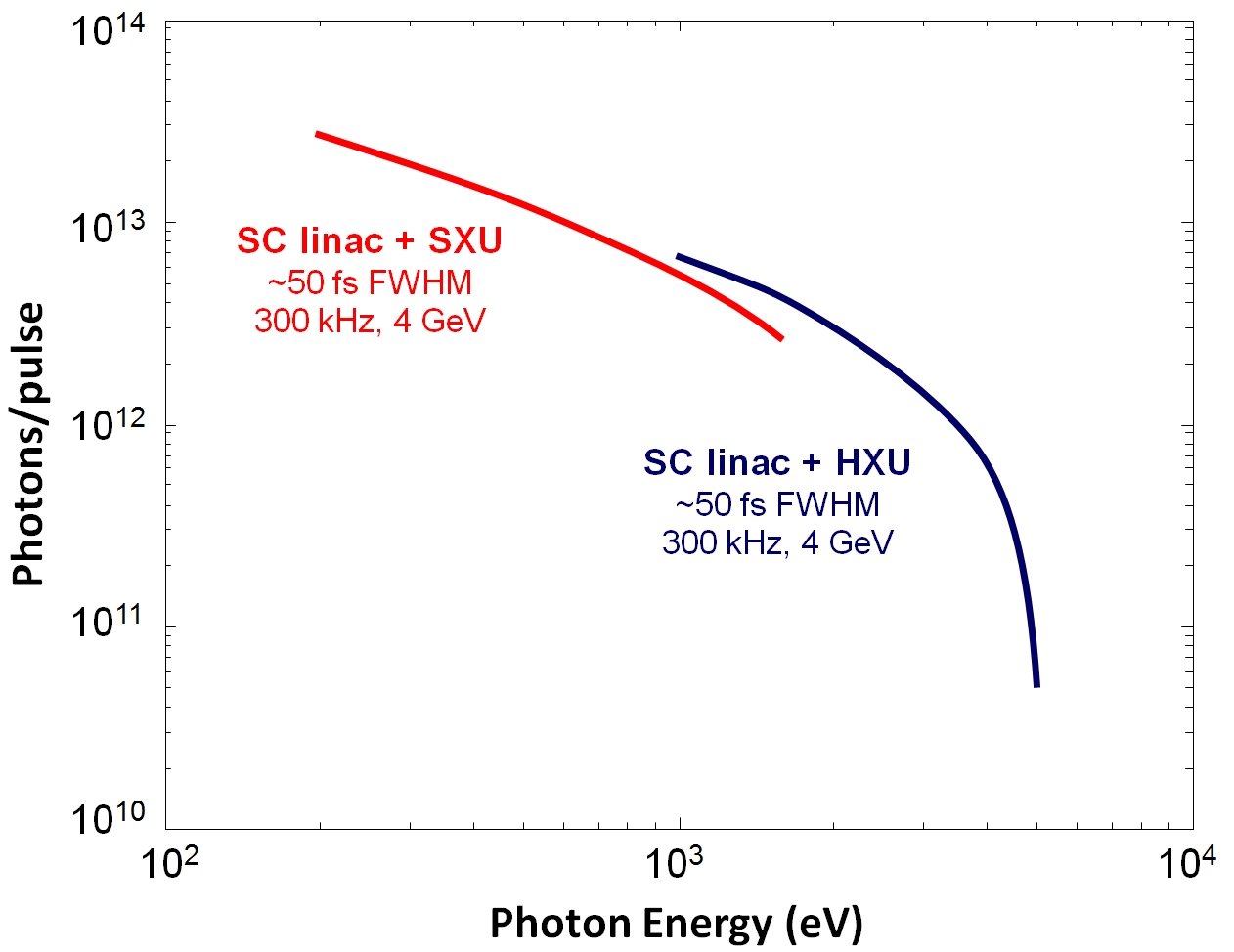
Calculated photons per pulse for high-repetition-rate operation from LCLS-II soft X-ray undulator (SXU) and hard X-ray undulator (HXU) at 4 GeV. Note that photons/pulse is constant with repetition rate up to ~300 kHz, and scales inversely with repetition rate above ~300 kHz. Also shown is the extended energy range from the Cu-linac (120 Hz) with the tunable HXU. (SLAC National Accelerator Laboratory)

LCLS-II photons per pulse.jpg

August 21, 2023
LCLS-II Image

Calculated photons per pulse for high-repetition-rate operation from LCLS-II soft X-ray undulator (SXU) and hard X-ray undulator (HXU) at 4 GeV. Note that photons/pulse is constant with repetition rate up to ~300 kHz, and scales inversely with repetition rate above ~300 kHz. Also shown is the extended energy range from the Cu-linac (120 Hz) with the tunable HXU. (SLAC National Accelerator Laboratory)

Download
Number of Slides
LCLS-II Image
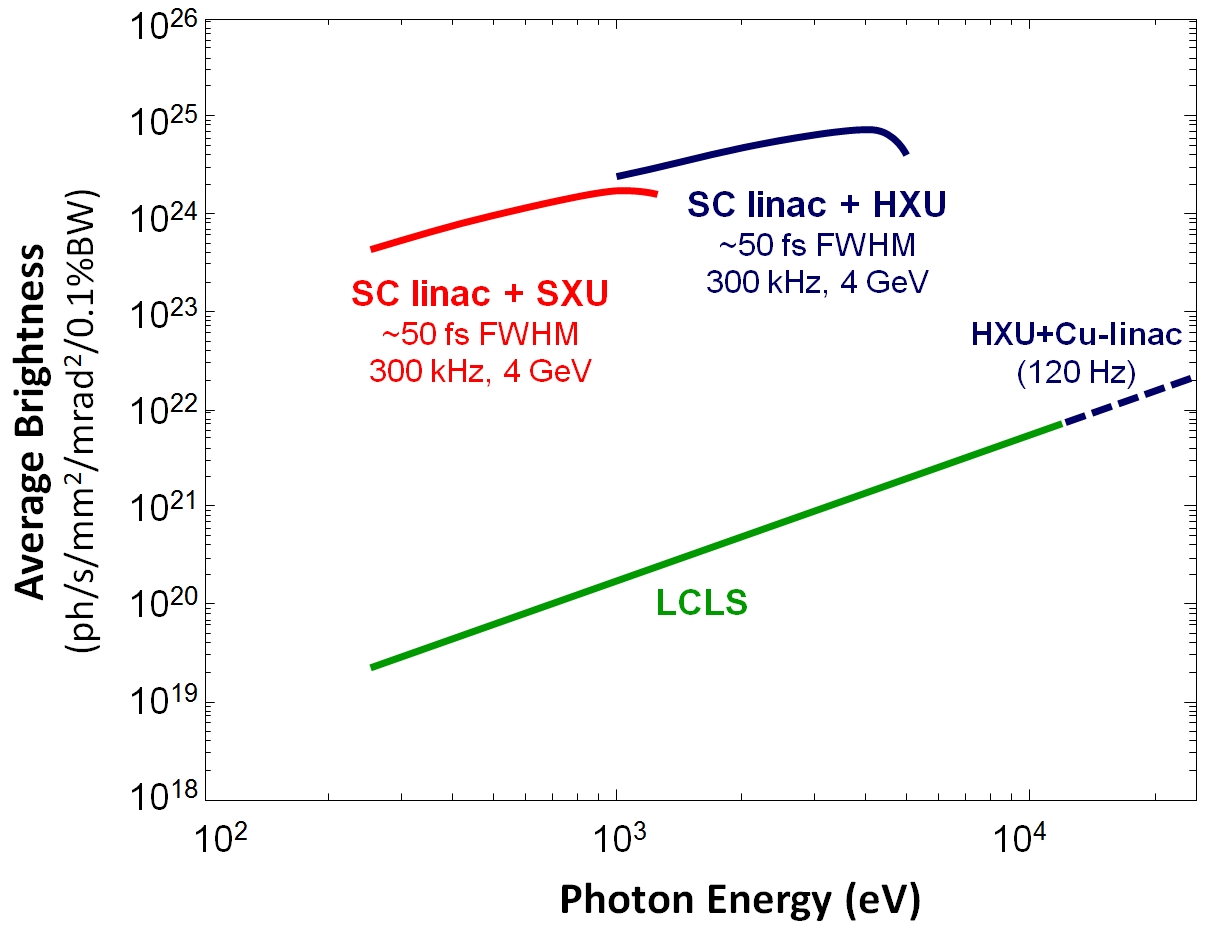
Calculated average spectral brightness for high-repetition-rate operation from LCLS-II soft X-ray undulator (SXU) and hard X-ray undulator (HXU) at 4 GeV. Note that LCLS-II average brightness is roughly constant above ~300 kHz (energy/pulse scales inversely with repetition rate above ~300 kHz). (SLAC National Accelerator Laboratory)

LCLS-II average brightness.jpg

August 21, 2023
LCLS-II Image

Calculated average spectral brightness for high-repetition-rate operation from LCLS-II soft X-ray undulator (SXU) and hard X-ray undulator (HXU) at 4 GeV. Note that LCLS-II average brightness is roughly constant above ~300 kHz (energy/pulse scales inversely with repetition rate above ~300 kHz). (SLAC National Accelerator Laboratory)

Download
Number of Slides
LCLS | Linac Coherent Light Source
2575 Sand Hill Road MS103
Menlo Park, CA 94025
  • Facebook
  • Twitter
  • Instagram
  • Flickr
  • Youtube
  • LinkedIn
  • Staff portal
  • Privacy policy
  • Accessibility
  • Vulnerability disclosure
SLAC
  • SLAC home
  • Maps & directions
  • Emergency info
  • Careers

© 2026 SLAC National Accelerator Laboratory is operated by Stanford University for the U.S. Department of Energy Office of Science.

Stanford University U.S. Department of Energy
Top Top
Back to top Back to top