
MAT Research Interests

The department pursues diverse research interests spanning the investigation of emergent quantum phenomena in materials to studies of heterogeneity and fluctuations in real-world materials and devices. Our research encompasses smallest and fastest processes driving quantum phenomena in materials, to investigation of nanoscale processes, including nucleation and phase transitions that drive synthesis and material transformation, control viscosity and rheological properties of liquids and gels, and critical rare events that influence the performance and lifetime of devices such as microelectronics and Li-ion batteries.
To achieve these scientific goals, we advance experimental methodologies that exploit the unique characteristics of MeV Ultrafast Electron Diffraction (MeV-UED) and the exceptional brilliance, coherent volume, and pulse structure of high repetition rate X-ray laser (LCLS-II, LCLS-II-HE). These cutting-edge techniques generate vast quantities of data at unprecedented rates. We therefore leverage rapidly evolving Artificial Intelligence and Machine Learning methods—including Physics-Informed Neural Networks, Bayesian Optimization, Diffusion Models, and Vision Transformers—to bridge the gap between data collection rates and scientific insight generation.
Research Topics
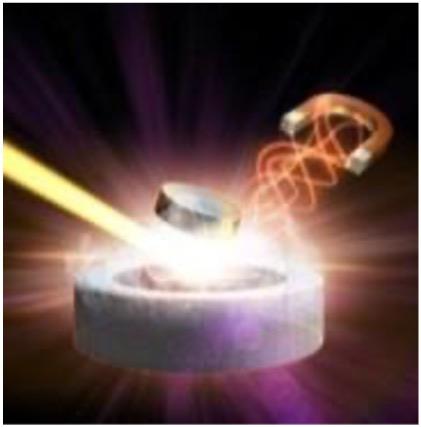
Quantum materials are substances whose properties cannot be explained by classical physics, exhibiting unexpected behaviors due to strong quantum effects like entanglement and coherence. These materials hold the keys to revolutionary technologies, from high-performance magnets and room-temperature superconductors to quantum computers. Unlocking their potential requires solving one of physics' greatest challenges: predicting how quantum properties emerge from complex charge-spin-orbital-lattice interactions.
A central theme in this field is the study of strongly spin-orbit coupled materials, where entangled spin, charge, and orbital degrees of freedom stabilize novel quantum phases and enable new routes to control electronic and magnetic properties. Understanding these relationships will enable rational orchestration of chemistry, structure, and control parameters—including strain and magnetic fields—to create desired functionality.
LCLS instruments uniquely map ground-state collective modes with unprecedented spectral, temporal, and spatial resolution. These collective modes represent the essential observables of quantum-coupled systems, particularly in complex and low-dimensional systems such as spin-frustrated Kagome lattices and moiré van der Waals heterostructures that generate today's most exciting quantum phenomena. Together, these systems not only challenge our fundamental understanding of condensed matter physics but also hold the promise for transformative technologies in quantum information and energy applications.
Focus Areas:
- Unconventional superconductors and strongly correlated electron systems
- Topological states of matter and exotic quantum phases
- Strongly spin-orbit coupled materials
- Magnetic materials spanning strong ferromagnets to skyrmions and spin glasses
- Ferroelectrics and complex topological states
- Structured illumination and coherent control of quantum states
The discovery of matter's atomic nature fundamentally transformed materials understanding, enabling the technological revolution that defines the modern world. True materials mastery requires understanding microscopic phenomena spanning multiple length scales while remaining rooted in nanoscale dynamics occurring at extraordinary speeds—often within picoseconds. Even macroscopic changes unfolding over years result from cascades of countless stochastic ultrafast events, creating variability and heterogeneity that affect even seemingly homogeneous materials.
Understanding the intertwined roles of spin, charge, and orbital order is central to unraveling these phenomena and their concomitant phase transitions. Their competing interactions often give rise to rich fluctuations that drive novel states of matter, from skyrmions and other exotic magnetic textures to transient phases in classical crystals. Probing these interactions on ultrafast timescales has opened the field of ultrafast magnetism, where femtosecond-scale dynamics reveal how spins respond and couple to electronic and lattice degrees of freedom.
Many such complexity can only be understood by observing nanoscale ultrafast processes as they occur and influence subsequent events. LCLS's ultrafast, fully coherent probes capture sub-nanosecond fluctuations and nanoscale dynamical heterogeneity, providing essential insights into the fundamental processes driving complex materials and devices. Complementary insights arise from studying structural dynamics, which capture how atomic-scale distortions and phonon modes mediate and stabilize these intertwined orders, ultimately shaping the macroscopic functionalities of these materials.
This research area also encompasses soft matter systems such as colloids, liquid crystals, and glasses that exhibit rich structural and dynamical behaviors emerging from competing interactions across multiple length and time scales. Using X-rays to probe the bulk, these materials display unique ordering phenomena and transport properties that are highly sensitive to confinement and external stimuli. A critical frontier is probing and controlling their ultrafast dynamics, where femtosecond to picosecond processes govern relaxation pathways, phase transitions, and collective excitations.
Focus Areas:
- Emergence of order from disorder, including nucleation and phase transitions
- Ultrafast magnetism and femtosecond-scale spin dynamics
- Structural dynamics and phonon-mediated ordering
- Viscosity and rheological properties of liquids and gels, including fragile-to-strong transitions and critical behavior in fluids and glass transitions
- Critical rare events affecting device performance


