
MeV-UED Run 7 Scientific Capabilities
SLAC MeV-UED Run 7 will provide support for materials science research and materials under extreme conditions communities. SLAC MeV-UED has led to a new paradigm in ultrafast electron scattering by employing higher electron beam energy, resulting in stronger diffraction and significantly reduced space-charge effects, enabling atomic spatial resolution alongside subpicosecond temporal resolution.
See full proposal call announcement
MeV electrons experience less multiple-scattering and exhibit a "real" flat Ewald-sphere. MeV-UED thus facilitates quantitatively-understood observables to validate physical modeling. MeV-UED has enabled broad scientific opportunities in ultrafast structural dynamics and chemical dynamics, including the first observation of the transition of heterogeneous to homogeneous melting, mapping the energy flow in superconductors, atomic movie capturing light-induced structural distortions in perovskite solar cells, and the discovery of a novel method of switching exotic properties on and off in topological material (SLAC-MeV-UED Pub).
MeV-UED will offer two specialized chambers dedicated to solid-state experiments. The first chamber, designated as the Cryo and Quantum Materials Chamber, is optimized to facilitate experiments conducted at or below room temperature and features a tunable optical pump. The second chamber, known as the Single-Shot and High Temperature Chamber, offers a range of configurations to accommodate versatile experimental requirements. These configurations include single-shot experiments, high-temperature experiments (from RT to 800 K), and experiments involving electrical excitation or biasing. Detailed specifications of the available options are outlined below. For additional information and to discuss experimental feasibility, please reach out to the UED instrument team. We highly encourage potential users to contact us with any special requirements they may have.
Contents
- Cryo and Quantum Materials Chamber
- Single Shot & High Temperature Chamber
- Single Shot & High Temperature Chamber Operational Modes
- Optical Laser Properties
- Detectors
- Sample Considerations
Cryo and Quantum Materials Chamber
This chamber is configured for measurements of structural dynamics from RT to cryogenic temperature and it is the primary chamber for most solid state UED experiments. The chamber configuration is kept relatively static to ensure the best performance of the cryo system. The chamber is located closer to the UED gun than the 2nd chamber enabling slightly higher time resolution, and slightly lower electron beam emittance than in the 2nd chamber. However, the proximity to the UED gun requires a cleaner vacuum environment.
Parameter | Value | ||||||||||||
|---|---|---|---|---|---|---|---|---|---|---|---|---|---|
Location | Upstream chamber (~1.5 m from the electron gun) | ||||||||||||
Measurement | Transmission ultrafast electron diffraction | ||||||||||||
Sample Temperature | <30 K – 300 K * *Temperature in the range 15 – 30 K may be achievable in certain circumstances, please discuss feasibility with UED staff | ||||||||||||
Samples | 3 mm TEM style grids* (10 samples max) *Larger samples can be accommodated but low temperature performance will degrade | ||||||||||||
Vacuum Level | < 10-8 Torr * *Samples and user components need to be compatible with HV/UHV ** Chamber is not suitable for experiment that require venting during an experiment | ||||||||||||
Electron Beam Parameters | 2 - 4 MeV 1 - 100 fC (104 - 106 electrons / pulse) Single shot - 540 Hz (1080 Hz*) < 150 fs FWHM pulse duration (charge dependent) 70 - 100 um diameter at sample (typical) *reduced e-beam stability energy | ||||||||||||
Sample Motions | Six axis motion stage
*depends on constraints | ||||||||||||
Laser Pump wavelengths | 800 nm, 400 nm, 266 nm, 200 nm OPA -- UV to 12 um * See detailed laser parameters below ** Please contact staff for details and to discuss complexities related to UED-THz experiments |
Single Shot & High Temperature Chamber
This chamber allows maximum user versatility. It can be reconfigured into any one of several different modes depending on user requirements. Three operational modes are offered in this chamber during UED run 7: solid state single-shot UED, high-temperature (300 K - 800 K) UED, and electrical pump/bias UED. Experiments using novel user-provided sample environments will only be considered for this chamber (please discuss feasibility with UED staff prior to submission).
Parameter | Value | ||||||||||
|---|---|---|---|---|---|---|---|---|---|---|---|
Location | Downstream chamber (~2.25 m from the electron gun) | ||||||||||
Measurement | Transmission ultrafast electron diffraction | ||||||||||
Operational Modes | Solid state single-shot UED | ||||||||||
High temperature UED | |||||||||||
Electrical excitation or biasing | |||||||||||
Sample Temperature | RT (see modes) | ||||||||||
Samples | Requirements vary depending on mode (see modes tables for details) | ||||||||||
Vacuum Level | < 10-6 Torr * *Samples and user components need to be compatible with HV ** Chamber pump down to operation ~1 hour | ||||||||||
Electron Beam Parameters | 2 - 4 MeV 1 - 100 fC (104 - 106 electrons / pulse) Single shot - 540 Hz (1080 Hz*) ~ 200 fs FWHM pulse duration (charge dependent) 100 um diameter at sample (typical) *reduced e-beam stability energy | ||||||||||
Sample Motions | Five axis motion stage
*depends on constraints and mode (no rotation about beam axis) | ||||||||||
Laser Pump wavelengths | 800 nm, 400 nm, 266 nm OPA UV - 2 um (See detailed laser parameters below) |
Single Shot & High Temperature Chamber Operational Modes
Single Shot Mode — Single Shot & High Temperature Chamber
This mode operation allows irreversible solid state experiments to be performed. A large array of identical samples are used and after each measurement a fresh sample is moved into the beam. Major areas of science addressed using this technique are ultrafast melting dynamics, irreversible phase transitions, warm dense matter and the potential for dynamic compression.
Parameter | Value |
|---|---|
Samples | Accessible sample area 25 x 45 mm 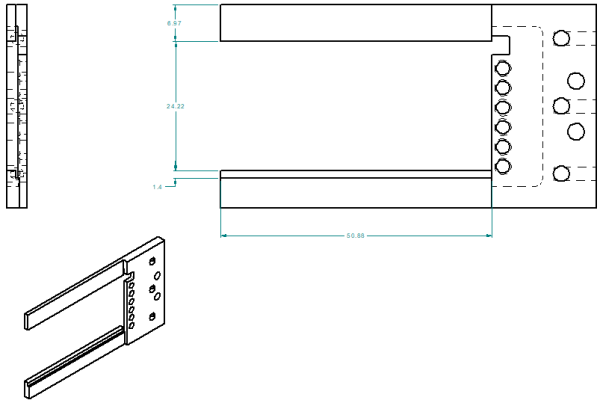
Example of a fork sample holder designed for a 27 x 50 mm2 Si chip with an array of freestanding membrane windows. The samples slightly overfilled the accessible area. *Please contact UED staff about custom mounts Max throughput: 2000-3000 samples per chip with 12 hours typical measurement time |
Sample Temperature | RT (Discuss with staff about experiments above and below RT) |
Electron Beam Parameters (typical) | 2 - 4 MeV 20 - 100 fC (105 - 106 electrons / pulse) ~200 um diameter spot at sample <1 Hz (sample alignment dependent) < 200 fs FWHM pulse duration (charge dependent) |
Optical Pump | See laser parameters table below for pulse energies |
High Temperature Mode — Single Shot & High Temperature Chamber
In a newly offered mode, a new custom sample holder with integrated heaters allows the precise control of the sample temperature from RT to 800 K. This facilitates exploring solid-solid phases transitions, quantum order, and structural dynamics at elevated temperatures.
Parameter | Value |
|---|---|
Samples | Up to nine 3 mm TEM style grids (Si3N4 or Mo are suggested as preferred grid materials) |
Sample Temperature | RT -- 800 K +/- 0.1 K stability over 1 hour +/- 1 K uniformity |
Additional Constraints | Rotations about the pitch and yaw axes are limited to ~22 degrees due to shadowing by the sample holder. |
Electrical Pump/Bias Mode — Single Shot & High Temperature Chamber
Electrical pulses synchronized to the UED pulses are provided to allow electrical excitation and/or dynamic biasing of the sample or device. This mode is provided to allow UED to address structural dynamics of in-situ micro-electronic systems under operating conditions. It is assumed that users will provide the sample ‘device’ on a thin film window suitable for UED experiments.
Parameter | Value | |||||||||
|---|---|---|---|---|---|---|---|---|---|---|
Samples | Please contact Alex Reid to discuss sample integration | |||||||||
Electrical Pulses
| Values represent pulse durations and amplitudes in an 50 Ohm impedance matched device.
Pulses generated with SRS DG645 with optional SRD1 attachment (DC biasing is also feasible) (Contact staff for information about integrating user supplied electronics) | |||||||||
Electron Beam Parameters | 2 - 4 MeV 1 - 100 fC (104 - 106 electrons / pulse) Single shot, 120 Hz, 180 Hz, 360 Hz, 540 Hz (1080 Hz*) ~ 200 fs FWHM pulse duration (charge dependent) 100 µm diameter spot at sample (for probing smaller devices it is suggested that the active area is placed a suitably sized aperture, e.g. 20 x 20 µm2 Si3N4 window) *reduced stability |
Optical Laser Properties
Parameter | Value |
|---|---|
Repetition rate | Single shot, 120 Hz, 180 Hz, 360 Hz (1080 Hz*) |
Typical optical pulse energy | > 8 mJ @ 800 nm > 0.8 mJ @ 400 nm > 0.08 mJ @ 266 nm ~ 16 µJ @ 200 nm For pulse energies at specific wavelengths (e.g 240 nm - 12 µm tunable) or other details please contact Patrick Kramer. |
Nominal pulse duration | 75 fs (FWHM)* * Depends on the wavelength **Tunable pulse durations up to 10s of ps at 800 nm with potential applications in ps laser heating and dynamic compression studies. . |
Optical delay | 0 - 1.5 ns* (physical delay stage) *Please contact UED staff for longer delay time ** Depends on the wavelength |
Optical spot size | Profiles available:
*800 nm and 400 nm only, please contact Patrick Kramer. |
Detectors
Two detectors are offered for run 7. A magnetic telescope is available for increased q-resolution for measurements in the Cryo/QM chamber. This lens system has been commissioned for use with the Andor detector, but use with the ePIX may also be possible. Please contact UED staff for more information.
P43 phosphor screen & | |
|---|---|
Phosphor thickness | 50-100 um |
Point-spread-function | 85 µm (rms) |
Pixel size | 13 x 13 µm2 |
Sensor size | 1024 x 1024 |
Data format | .tiff |
Pixel well depth | 80k e- |
ePIX detector - | |
|---|---|
Pixel size | 100 x 100 um2 |
Frame rate | 540 Hz |
Sensitive area | 5 x 5 cm2 |
Gain | 3 fixed plus 2 with auto ranging and programmable switch point |
S/N in High Gain per MeV electron | 530 |
Sample Considerations
All UED experiments are conducted in transmission geometry. It is important that samples are sufficiently thin to allow the MeV beam to transmit to the detector. The following is given as general guidance for the thickness of UED samples and their supports. Users will be required to ship samples to SLAC before any allocated beamtime to allow time for installation and screening. Screening of samples may be required before an experiment. Please contact your assigned UED Point of Contact (POC) for details.
Samples should be thin, of the orders of 10s of nm, with only an essential support. Commercial TEM grids, either mesh grids or Si3N4 chips, are ideal sample supports. The electron beam size at the sample is typically ~100 um diameter. Samples that are smaller than 10 x 10 um2 may prove difficult to measure due to low scattering signal. The sample thickness and support requirements are UED technique dependent. The following table summarizes these different requirements.
Post-sample apertures down to 15 micron diameter are available for the selection of small sample regions for measurement. The apertures are mounted on translation stages downstream of the sample and can be used to select a small region of a larger sample, or a single sample flake while masking nearby flakes. Please contact UED staff for more information.
Technique | Comments | Thickness Range* |
|---|---|---|
Diffuse Scattering on single crystal samples examining phonon dynamics | Optimized thickness is vital as these experiments are cross section limited. Samples should be freestanding or on ultra thin substrates as diffuse scattering is easily swamped by electron scattering for any support layer. | Low Z materials: <= 100 nm High Z materials: <= 15 nm
Support < 20 nm Si3N4 |
Debye Waller and Structure factor analysis | It is important to stay at thicknesses below significant multiple scattering.
Thin amorphous supports are ideal if required. | Low Z materials: < 200 nm High Z materials: < 30 nm
Support <= 50 nm Si3N4 |
Lattice deformation and superlattice order | Some multiple scattering can be tolerated.
Thin amorphous supports are ideal if required. | Low Z materials: < 300 nm High Z materials: < 50 nm
Support <= 50 nm Si3N4 |
*Please note that laser pump penetration may be an important additional consideration in many experiments.


